

 Eng
Eng  English
 中文简体
中文简体 Français
Content
- 1 What Is Glue-Down Engineered Hardwood?
- 2 Glue-Down vs. Floating vs. Nail-Down: Key Differences
- 3 Choosing the Right Adhesive for Glue-Down Installation
- 4 Subfloor Preparation: The Key to a Successful Glue-Down
- 5 Step-by-Step Glue-Down Installation Process
- 6 Common Mistakes and How to Avoid Them
- 7 Long-Term Maintenance and Removal Considerations
What Is Glue-Down Engineered Hardwood?
Glue-down installation permanently bonds each engineered plank directly to the subfloor using a high-strength adhesive. This method creates a solid, monolithic surface that won’t shift under foot traffic. It’s the preferred technique when you’re working over a concrete slab or in areas where nails can’t penetrate—think basements, high-rise condos, and commercial spaces that demand maximum stability.
Unlike floating floors that rest on an underlayment, a glued-down floor feels noticeably harder underfoot. There’s no hollow echo, and the tight bond limits movement between boards, which reduces the risk of squeaks over time. For many homeowners, the payoff comes during refinishing: a glued-down engineered floor can be sanded and recoated just like solid hardwood because it’s locked in place.
- Ideal for concrete subfloors, below-grade installations, and high-traffic zones
- Delivers superior acoustic dampening—footfall noise drops by 10–14 dB compared to floating installations
- Compatible with radiant heating systems when paired with a heat-resistant adhesive rated for at least 140°F
Manufacturers that produce engineered wood flooring designed for glue-down applications typically recommend a minimum 3 mm real wood veneer to permit future sanding. A thicker wear layer combined with a dense core—like high-density fiberboard (HDF) exceeding 900 kg/m³—improves adhesive absorption and dimensional stability.
Glue-Down vs. Floating vs. Nail-Down: Key Differences
Selecting the right installation method influences both upfront cost and the floor’s behavior over a decade of daily use. Plenty of installers default to nailing when a wood subfloor is available, and floating floors often appeal to DIYers because they’re faster to lay. Glue-down sits at the intersection of performance and permanence—but you pay for it in labor and material.
The table below breaks down the critical benchmarks so you can compare them side by side.
| Factor | Glue-Down | Floating (Click-Lock) | Nail-Down |
|---|---|---|---|
| Subfloor compatibility | Concrete slab, plywood, OSB | Nearly any flat, dry surface | Plywood or OSB only |
| Typical material cost per sqft | $1.50–$3.00 (adhesive only) | $0.30–$0.80 (underlayment) | $0.10–$0.30 (cleats/nails) |
| Labor (pro install) per sqft | $3.00–$5.00 | $1.50–$3.00 | $2.00–$4.00 |
| DIY difficulty | High—requires precise troweling | Low—click-together planks | Moderate—needs nailer and skill |
| Long-term floor feel | Solid, zero movement | Slight cushion, possible hollow spots | Solid, minor seasonal gap shifts |
| Refinishing potential | Excellent—floor stays fixed | Limited—movement can compromise sanding | Excellent—similar to solid hardwood |
| Removal difficulty | Hard—adhesive cleanup required | Easy—unclick and lift planks | Moderate—nail extraction needed |
| Average lifespan before first major repair | 20–25 years | 10–15 years | 20–25 years |
A glue-down floor costs more up front. Over a 15-year window, though, the ability to sand and recoat two or three times can push total ownership cost below that of a floating floor that must be replaced. For every 1,000 sqft, you’ll spend roughly $3,750–$8,000 on glue-down labor and adhesive, versus $1,500–$3,800 for floating. The payback comes if you refinish once instead of replacing.
Choosing the Right Adhesive for Glue-Down Installation
Adhesive selection makes or breaks a glue-down job. Three primary chemistries dominate the market: polyurethane (PU), silane-modified polymer (MS), and epoxy. Each behaves differently under moisture, temperature swings, and foot traffic. Solvent-based and dispersion adhesives should never touch engineered hardwood—they can bleed through the veneer or fail to cure properly over impermeable subfloors.
PU adhesives harden using ambient moisture and form a rigid, waterproof bond. They’re aggressive and fast, with a typical open time of 15–20 minutes. MS adhesives are more elastic, which absorbs subfloor micro-movements better—important over radiant heat. Epoxy offers the highest bond strength but demands a dry, meticulously clean concrete slab and carries a steep price tag.
| Adhesive Type | Coverage per Gallon | Cure Time (to light foot traffic) | VOC Level | Best Subfloor Match | Approx. Cost per 1,000 sqft |
|---|---|---|---|---|---|
| PU (1-component) | 50–70 sqft | 12–16 hours | <100 g/L | Concrete, plywood, OSB | $2,200–$3,200 |
| MS polymer | 45–65 sqft | 18–24 hours | 0–30 g/L | Concrete with radiant heat, plywood | $2,800–$4,000 |
| Epoxy (2-component) | 40–55 sqft | 8–12 hours | Varies; often <50 g/L mixed | Cured, dry concrete only | $3,500–$5,500 |
When bonding over concrete, always confirm the slab’s relative humidity stays at or below 4% (RH) before adhesive application. Damp concrete will shorten open time and can cause adhesive emulsification, leading to plank detachment within weeks. For HDF engineered flooring, MS adhesives are often recommended because the polymer’s slight flexibility compensates for the core’s lower thermal expansion coefficient.
Subfloor Preparation: The Key to a Successful Glue-Down
A flawless installation starts with a subfloor that meets tight tolerances. Concrete slabs must be clean, flat, and dry. Any deviation beyond 3/16 inch over a 10-foot span will telegraph through the planks and can cause hollow spots or bond failure. High spots get ground down; low areas demand a cement-based self-leveling compound applied according to the manufacturer’s wet-film thickness guidelines.
Moisture control is even more critical. Use an in-situ relative humidity probe for concrete: 4% RH is the safe ceiling for glue-down engineered hardwood. Calcium chloride tests (the older CM method) should read ≤2% for cementitious slabs and ≤0.5% for anhydrite. When readings creep above those thresholds, stop and install a two-part epoxy moisture barrier before spreading any adhesive.
Wood subfloors need to be securely fastened with no squeaks, and panel edges that telegraph through must be sanded flush. The entire surface gets vacuumed and wiped with a tack cloth to remove dust that would otherwise weaken the adhesive bond. Skipping this step leads to adhesive failure that shows up as popping noises when you walk across the floor.
- Concrete RH max: 4%. Exceed it, and a moisture mitigation system becomes mandatory before adhesive rolls out.
- Flatness tolerance: ≤3/16 inch in 10 feet. Use a 10-foot straightedge to check; fill any gap beyond a credit card’s edge.
- Cure time for patch compound: 24–48 hours before moisture testing, depending on depth. Rushing this causes trapped moisture.
- Surface temperature: Maintain 65–85°F during installation. Cold slabs slow adhesive cure and extend open time unpredictably.
In commercial projects where Jesonwood’s plank floors are specified, installers routinely run a rapid RH test 48 hours before the build, even if prior readings were acceptable. Concrete conditions can shift quickly when HVAC systems are turned on for the first time.
Step-by-Step Glue-Down Installation Process
Professionals follow a sequence that leaves little room for improvisation. Rush any single step and the glue won’t transfer correctly, creating voids that compromise the entire floor’s stability. The process below assumes a properly prepared subfloor and the recommended trowel notch depth is 1/4 inch by 3/16 inch for most 5/8-inch engineered planks.
- Acclimate unopened plank cartons in the installation space for at least 48 hours. Stack them flat, not on edge, with spacers allowing air circulation. The room’s temperature must stay between 65°F and 75°F, with relative humidity between 35% and 55%.
- Spread the adhesive using the manufacturer-specified V-notch trowel, working in small sections of 2–3 rows at a time. Keep the adhesive’s open time in mind—most PU adhesives remain workable for 15–20 minutes. If the adhesive skins over, scrape it off and re-apply.
- Set the first row against a chalk line, using spacers along the wall to maintain a 1/2-inch expansion gap. Press each plank firmly into the adhesive with a twisting motion to break any surface tension and ensure full transfer onto the board’s back.
- Stagger end joints by at least 8 inches from row to row. Use a tapping block to close side and end joints without damaging the edges. Never hammer directly on the tongue; fractured tongues lead to edge peaking later.
- Check for hollow spots by tapping the surface with a screwdriver handle every 15–20 planks. A solid, high-pitched report means good adhesive contact. A dull thud means a void—pull the plank immediately and re-trowel the adhesive.
- Wipe off any adhesive squeeze-out with a manufacturer-approved cleaner within the recommended working window. Mineral spirits can damage some prefinished coatings; test on a scrap piece first.
- After the final plank is set, place heavy, evenly distributed weights over the entire floor—boxes of planks work well—for 12–24 hours. This ensures consistent bond contact during the critical initial cure phase.
- Remove spacers, install baseboards or quarter-round trim to cover expansion gaps, and allow the floor to rest for 24 hours before returning heavy furniture to the room. Full adhesive cure typically takes 48–72 hours.
For floors installed over radiant heating, run the system at 65°F for 48 hours prior to installation, then hold that temperature constant during the entire gluing and curing period. Raise the temperature no more than 5°F per day afterward until you reach the target operating temperature, which must never exceed 85°F at the subfloor surface.
Common Mistakes and How to Avoid Them
Even experienced contractors can trip over these five failure points. Every one costs time and money, but each has a straightforward fix.
- Moisture-overload subfloor: Gluing over a slab with RH above 4% or a wood subfloor above 12% MC causes adhesive degradation and cupping. Always test with a pin-type meter for wood and an in-situ probe for concrete at the time of installation, not weeks earlier.
- Insufficient adhesive transfer: Using the wrong trowel size or pressing planks without a twisting motion leaves gaps. Verify at least 90% adhesive transfer by periodically lifting a plank within the first 5 minutes of placement.
- No perimeter expansion gap: Engineered hardwood still moves with humidity changes. Omitting the 1/2-inch gap leads to buckling. Spacers are cheap insurance; removing them too early invites trouble.
- Floor not acclimated to site conditions: Planks that reach moisture equilibrium with the room before gluing move less afterward. Keep cartons in the space with HVAC running for a full 48 hours. Skipping this can cause post-installation seam gapping.
- Expired or frozen adhesive: Check the manufacturing date. Shelf life is typically 12 months for unopened PU and MS adhesives. Adhesive that has been frozen and thawed will not cure uniformly, so store and transport above 50°F.
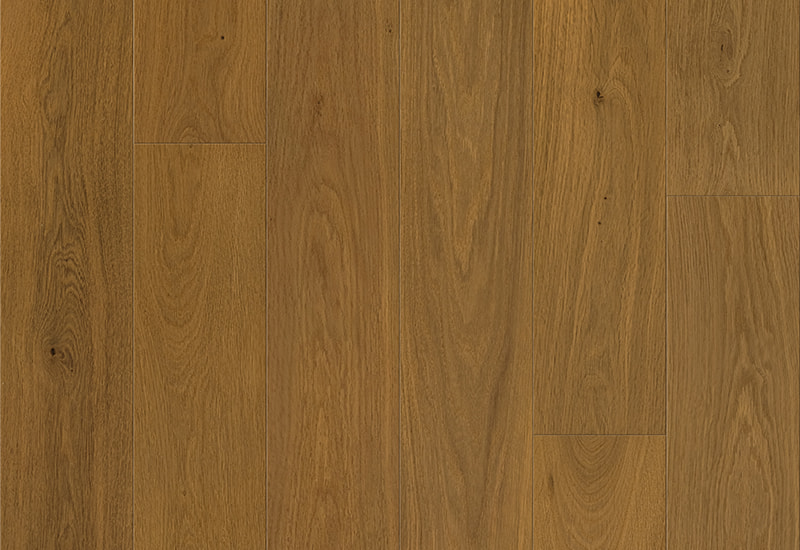
If you’re installing a warm-toned white oak engineered plank, these precautions become even more critical. Wider planks—7 inches and above—exert greater stress on the glue line, demanding pristine subfloor flatness and full adhesive coverage.
Long-Term Maintenance and Removal Considerations
A glue-down engineered floor can look new for 15–20 years if you stick to a few non-negotiable rules. Dry cleaning methods dominate. Microfiber dust mopping and vacuuming with a bare-floor attachment prevent grit from grinding into the finish. When spot cleaning is needed, a lightly dampened—not wet—pad removes smudges without driving moisture into the seams.
Refinishing is the glue-down floor’s hidden value. Because the planks don’t move, a professional can sand off 0.5–1 mm of the wear layer and apply a fresh coat of polyurethane 2–3 times over the floor’s lifespan, depending on the original veneer thickness. A 3 mm wear layer supports two refinishes; 4 mm supports three or more. This extends the floor’s usability far beyond what a floating floor can offer, since a floating floor’s micro-movement often makes heavy sanding unworkable.
Removal, however, is labor-intensive. The adhesive bond is tenacious. Demolition crews charge $2 to $4 per square foot to scrape a glued-down hardwood floor off concrete, a price that shoots up if the adhesive must be mechanically ground down to restore the slab for new flooring. By contrast, pulling up a floating floor costs $0.50 to $1 per square foot and leaves the subfloor virtually untouched.
Over 20 years, the annualized cost difference between glue-down and floating narrows once you factor in a single refinishing versus a complete floating floor replacement. For a 1,000 sqft area, glue-down plus one refinish at year 15 averages about $0.65 per sqft per year, while a floating floor replaced at year 12 runs around $0.85 per sqft per year. Choose glue-down when longevity and refinishing flexibility rank higher than minimal upfront investment.

 +86-572-2118015
 No.598. Gaoxin Road, Huanzhu Industrial Zone, Huzhou City, Zhejiang Province, China, 313000