

 Eng
 English
 中文简体
 Français

Content
- 1 What a Hardwood Floor Moisture Meter Actually Measures
- 2 Pin and Pinless Meters Solve Different Problems on Site
- 3 The Numbers: 6% to 9% Is a Moving Target
- 4 Where Meter Readings Go Wrong
- 5 What the Meter Cannot Tell You: Drying History and Build
- 6 Solid, Engineered and Pattern Floors Behave Differently
- 7 Acclimation Is a Measurement Process, Not a Waiting Period
- 8 A Pre-Installation Moisture Checklist
A hardwood floor moisture meter answers one narrow question: how much water is bound inside the wood at this moment. That answer governs flatness, joint tightness and adhesive performance for the life of the floor, which makes a modest instrument the cheapest insurance on a job that costs many times more to redo.
Moisture content (MC) is not a fixed property of a board; it moves with the room. A plank that leaves a kiln at 8% may settle at 5% in a heated apartment in February and at 12% in a coastal house in July. The meter does not stop that movement, but it tells you where the wood sits relative to the space it is about to occupy, so an installation begins from a known position rather than an assumed one.
What a Hardwood Floor Moisture Meter Actually Measures
MC is expressed as a percentage of oven-dry mass: water weight divided by dry wood weight, multiplied by 100. A laboratory reaches that figure by drying a sample to constant weight under ASTM D4442. Field meters cannot weigh anything, so they measure a proxy. Pin meters apply a small voltage across two electrodes and read electrical resistance, which drops sharply as water content rises. Pinless meters generate a dielectric field and read how the material beneath the plate disturbs it.
Both methods are indirect and both convert their signal through a calibration curve built around a species group. Manufacturers typically claim accuracy of plus or minus 1 to 2 percentage points between roughly 6% and 25% MC, with readings degrading quickly outside that window. Two consequences follow. The number on screen is an estimate that needs species and temperature correction, and the meter only sees the wood inside its measuring field, not the whole board.
Pin and Pinless Meters Solve Different Problems on Site
The choice is not about which type is superior; it is about which layer of the assembly you need to interrogate. Insulated pins, coated except at the tip, can be driven to a set depth so surface and core readings are compared on the same board, which is the standard check for case hardening after drying. A pinless plate scans a finished floor in seconds without leaving a mark, yet on a 10 mm engineered plank over a damp slab the field may reach the concrete and report the slab rather than the wood.
| Meter type | Measuring depth | Strongest use on a flooring job | Typical failure |
|---|---|---|---|
| Insulated pin meter | 6-30 mm, set by pin coating | Comparing shell and core on solid boards; verifying subfloor and joists | Holes in finished faces; species and temperature error |
| Pinless capacitance plate | 10-40 mm, density dependent | Fast screening of installed floors and delivered cartons | Field reaches through thin planks into a damp substrate |
| Dual-depth pinless | Switchable shallow and deep | Judging the moisture gradient through a board | Wrong density setting skews absolute values |
| Thermo-hygrometer | Air only | Establishing target equilibrium and acclimation conditions | Treated as a wood reading, which it is not |
| In-situ RH probe (ASTM F2170) | 40% of slab depth | Qualifying concrete before a glue-down | Comparative surface readings accepted instead |
Most installers carry two instruments: a pinless plate for wide-area screening and a pin meter to confirm any reading that looks wrong. A thermo-hygrometer is not optional either, because without ambient temperature and relative humidity a moisture reading has no context.
The Numbers: 6% to 9% Is a Moving Target
Pre-finished hardwood flooring is normally kiln-dried to a shipping range of 6% to 9% MC. That band brackets the equilibrium moisture content of wood in a conditioned building at about 20 °C and 30% to 50% relative humidity. Push the room to 60% RH and equilibrium climbs with it; drop to 25% RH in winter and it falls towards 5%. A floor installed at 9% into a 5% environment will shrink and gap, and no amount of installer skill prevents it.
The working site rule is that flooring and subfloor sit within 2 percentage points of each other, loosening to about 4 points for plank wider than 76 mm. On concrete, comparative meter readings under ASTM F2659 are a screening tool only; the qualifying test is an in-situ relative humidity probe to ASTM F2170, usually capped at 75% to 80% RH before a wood floor goes down. Our reference guide on acceptable moisture levels in wood flooring sets out the 6-9% range and its measurement risks in more detail.
Where Meter Readings Go Wrong
Most moisture complaints trace back to a reading that was technically taken and practically meaningless. The familiar causes:
- Wrong species setting. White oak at roughly 0.75 specific gravity and cumaru near 1.0 do not respond identically to a dielectric field; a wrong density setting can shift a pinless result by 2 to 3 points.
- Cold wood. Below about 15 °C many meters read high, so stock pulled from a cold truck needs time to equilibrate before measurement.
- Surface-only sampling. Short pins read the shell of a case-hardened board and report a comfortable number while the core sits two points wetter.
- Coated faces. Aluminium oxide wear layers and thick UV lacquers add resistance, so readings must be validated against a bare edge or an offcut.
- Reused pin holes. A second insertion in the same hole reads the dried pocket left by the first.
- Instrument drift. A meter that lives in a hot vehicle or has been dropped drifts silently; check it against a calibration block before each project, not once a year.
What the Meter Cannot Tell You: Drying History and Build
A moisture reading describes a condition, never a cause. Two boards can both read 8% while one was dried on a slow schedule and the other left the kiln with residual stress that will surface as cupping or end lift months later. Buyers specifying container loads should ask about the drying record rather than the delivery sheet: batch-level MC figures, kiln schedule, the interval between drying and packing, and whether cartons were barrier-wrapped for the sea leg. Our own flooring manufacturing and quality control process samples every production stage for exactly this reason.
Construction matters as much as the raw figure. In a multilayer engineered plank, face and core are bonded in a balanced build, so the assembly absorbs seasonal swings far better than a solid board of the same species, which is why engineered formats dominate glue-down and underfloor heating projects.
 Natural White Oak Engineered Plank OA001-9Engineered build with a 2 mm white oak face helps buffer seasonal moisture swings, making it relevant for glue-down and underfloor heating projects.View Product →
Solid, Engineered and Pattern Floors Behave Differently
Movement scales with width and with how the board is built. A 20 mm solid white oak plank responds to a 3-point moisture swing with visible dimensional change across its width, while a cross-banded engineered plank of similar face species largely absorbs the same swing inside its core. Pattern floors add a second variable: edges. Herringbone and chevron cuts multiply the exposed end-grain joints per square metre, and end grain takes on and releases moisture far faster than a face. Those zigzag joints are where gapping appears first when a floor dries out, which is why pattern installations deserve more readings per room, not fewer.
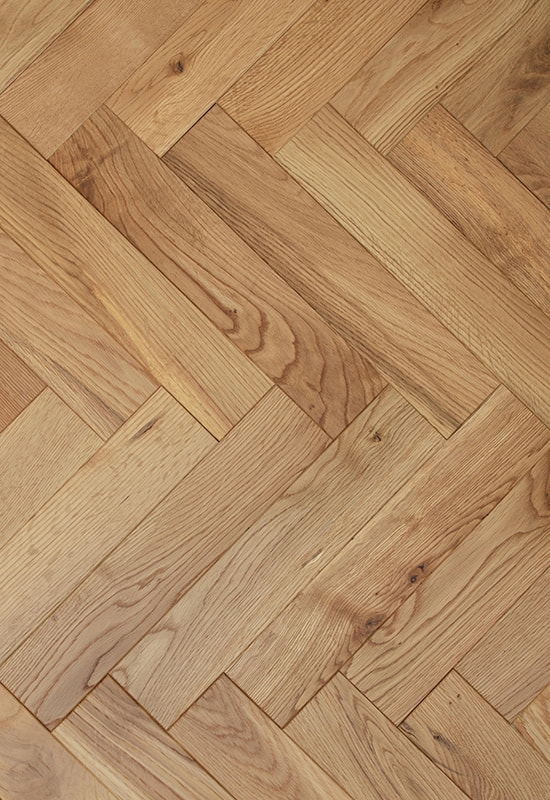
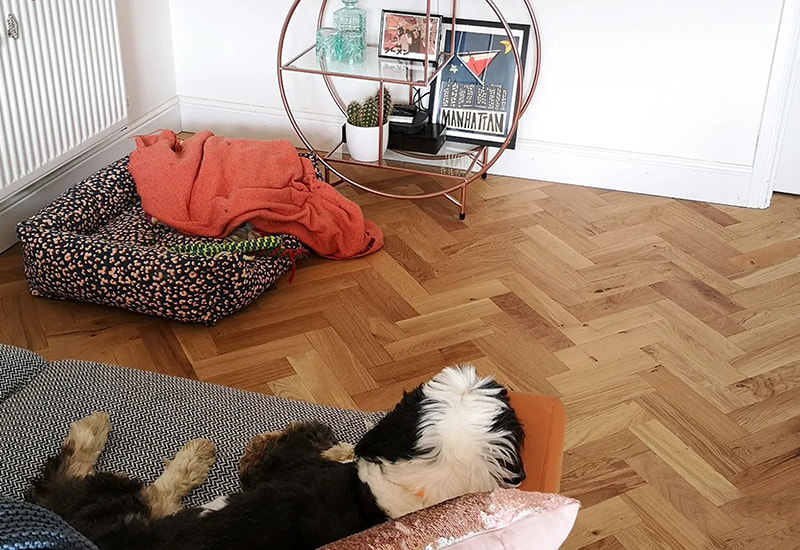 White Oak Natural Herringbone Engineered Flooring OA001-7Herringbone engineered white oak with plywood core and 3 mm top layer; pattern edges warrant careful moisture readings before acclimation.View Product →
Acclimation Is a Measurement Process, Not a Waiting Period
Acclimation means bringing flooring into the conditioned space, stacking cartons with spacers for air movement, and measuring the same sample points daily until readings stabilise and sit close to the expected in-service equilibrium. Opening cartons in an unheated shell, or next to wet plaster and screed, is not acclimation; it is exposure. Re-check the subfloor after other trades have finished, because concrete that passed a probe in week one can gain moisture from a leak or a fresh screed pour.
Solid boards need the full window, since there is no core to buffer movement. A 90 mm brushed white oak plank dried to the correct band is a stable floor in a stable room, but it has no reserve for a room that swings 20 points of relative humidity between summer and winter.
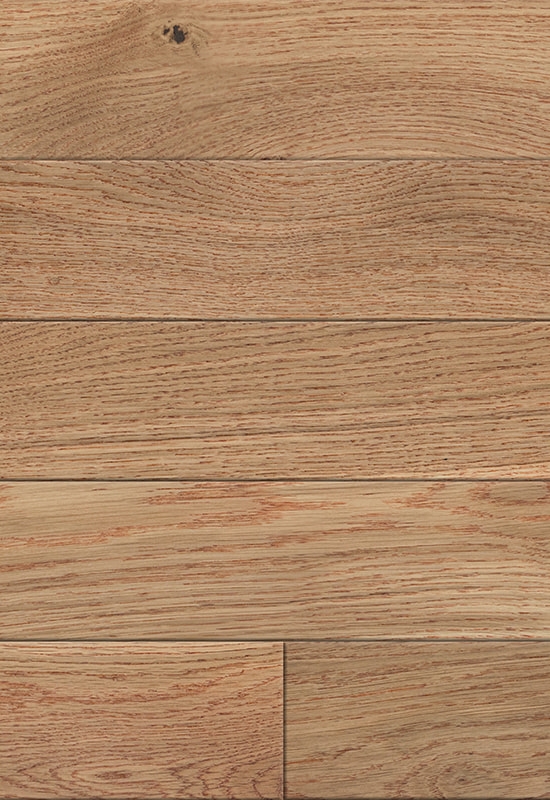
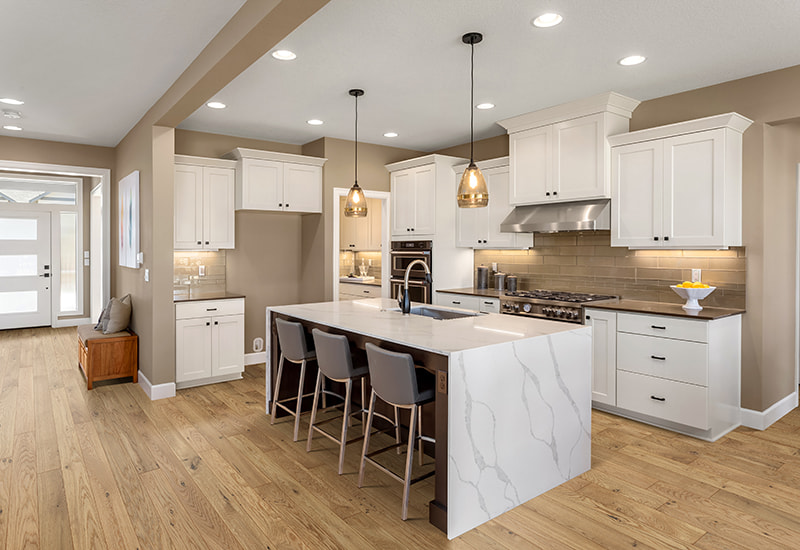 White Oak 90 Brushed Solid Wood FlooringSolid 90 mm brushed white oak plank with matte UV lacquer; no core to buffer humidity swings, so full acclimation and logged readings matter.View Product →
A Pre-Installation Moisture Checklist
- Condition the space first: 18-24 °C and 30-50% RH for at least 48 hours before any reading means anything.
- Verify the meter on a calibration block or sealed reference sample and record the deviation.
- Set species density and temperature compensation individually for every material tested.
- Take at least 20 readings per 100 m², with a minimum of 10 per room, and log the highest and lowest rather than the average.
- Measure subfloor and flooring within the same hour and compare against the 2-point rule, or 4 points for wide plank.
- On concrete, run an ASTM F2170 probe and file the result; comparative surface readings are screening only.
- Log species, date, location, meter model, mode, temperature, RH and reading, because that file is the evidence if a claim arrives eighteen months later.
The instrument is simple; the discipline around it is not. A single reading proves nothing. A logged set of readings, taken with a verified meter in a conditioned space and compared against both the subfloor and the expected in-service equilibrium, is what separates a floor that stays flat from a callback.
For buyers, the same logic applies upstream: specify a moisture band, ask for drying records per batch, and choose a construction whose build matches the climate the floor will live in.

 +86-572-2118015
 No.598 Gaoxin Road, Wuxing Area, Huzhou, Zhejiang, China, 313000
