

 Eng
Eng  English
 中文简体
中文简体 Français
Content
What Is HDF Engineered Wood Flooring?
HDF engineered wood flooring is a multi-layer flooring product built around a core made from High-Density Fiberboard (HDF) — an engineered panel material composed of recycled hardwood fibers compressed under extreme heat and pressure. On top of this dense core sits a real wood veneer, typically 2–6 mm thick, that delivers the authentic appearance and warmth of solid hardwood. A stabilizing backing layer completes the structure at the bottom.
What makes this construction distinct is the core material itself. Unlike traditional engineered wood, which uses a plywood base, HDF replaces those cross-laminated wood plies with a single, uniform slab of fiberboard. The result is a floor that looks indistinguishable from solid wood but behaves more predictably under changing conditions of temperature and humidity.
If you are exploring options, you can browse our full range of HDF engineered wood flooring to see how this construction translates into finished products ready for residential and commercial projects.
How HDF Core Is Made
The manufacturing process behind an HDF core is what sets it apart from other board materials. Factories begin by collecting wood residues — off-cuts, defective veneers, and sawmill waste — and grinding them down into fine wood fibers. These fibers are then blended with a bonding resin and fed into a continuous press that subjects the mixture to temperatures exceeding 180 °C and pressures of several hundred bar.
This compression process drives out virtually all air pockets and moisture, producing a panel of remarkable uniformity and density. The finished HDF board typically achieves a density of 800–900 kg/m³, compared to around 600 kg/m³ for standard MDF. That difference in density is not merely a number on a data sheet — it directly translates into a harder, more impact-resistant surface beneath your wood veneer. For a detailed breakdown of how HDF compares to MDF on a material level, see our article on HDF vs. MDF: key differences explained.
Reputable manufacturers also ensure that the resins used in this process conform to low-emission standards such as the European E1 classification or the US CARB Phase 2 requirements, keeping formaldehyde emissions well within safe limits.
Key Performance Advantages
The dense, homogeneous structure of an HDF core delivers several practical performance advantages that buyers will notice over years of use.
- Dimensional stability. Because the fibers run in all directions throughout the panel — rather than in alternating plies like plywood — HDF resists the directional movement that causes solid wood to cup or bow. The floor expands and contracts evenly across the entire plank, which matters enormously in rooms that experience seasonal humidity swings.
- Surface hardness and dent resistance. With a Janka hardness rating of approximately 1,700 lbf for the core alone, HDF provides a harder substrate than many plywood cores, which range from 500 lbf for poplar to around 1,200 lbf for birch. Furniture legs, high heels, and dropped objects cause less damage when the material beneath the veneer is this dense.
- Consistent thickness tolerance. HDF is manufactured to very tight thickness tolerances — often within ±0.1 mm across a full panel. This consistency makes it easier to achieve a flat, gap-free installation, particularly when using click-lock floating systems.
- Better acoustic performance. The density of HDF also contributes to sound damping. Footstep noise and impact sound transmission are reduced compared to hollow or less-dense substrates, an advantage that is especially relevant in multi-story buildings.
Why HDF Flooring Dominates the European Market
Europe is, by some estimates, the largest single market for engineered wood flooring in the world, and HDF-core products have carved out a dominant position within it. Several interconnected factors explain this preference.
Underfloor heating compatibility. Radiant underfloor heating (UFH) is standard in new residential construction across Germany, Scandinavia, the Netherlands, and much of Central Europe. Solid hardwood performs poorly over UFH because the repeated heating and cooling cycles cause it to crack and gap. HDF engineered flooring handles these thermal cycles with minimal movement, making it the architect's and builder's default specification for any project with a heated screed. Our guide on engineered wood flooring with underfloor heating explores this compatibility in depth.
Strict environmental regulations. The EU's REACH regulation and the E1/E0 formaldehyde emission standards have pushed the European flooring market toward materials that are both low-emission and resource-efficient. Because HDF cores are manufactured from recycled wood fiber rather than virgin timber, they align well with circular-economy principles. European buyers — both consumers and procurement managers — increasingly view this as a baseline requirement rather than a premium feature. For more on this topic, read our article on the environmental benefits of HDF flooring.
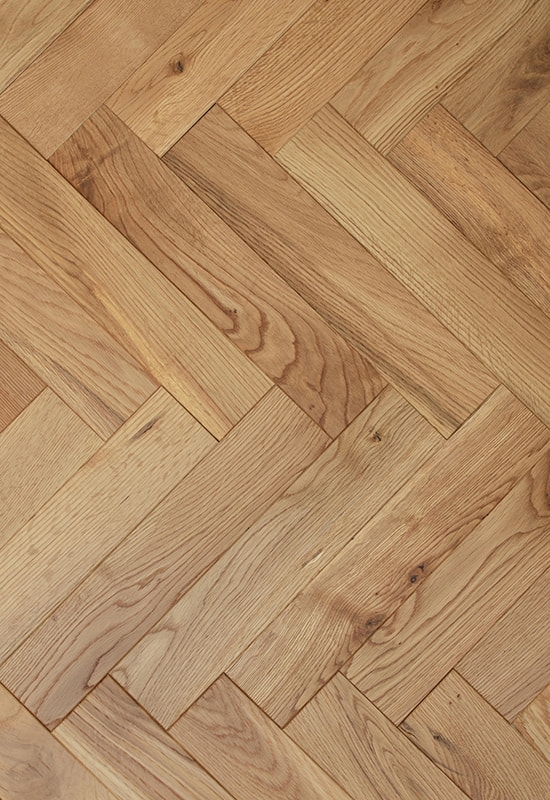
The herringbone and parquet revival. Over the past decade, classic European parquet patterns — particularly herringbone and chevron — have returned to mainstream interior design. HDF's consistent thickness and tight dimensional tolerances make it far easier to achieve the tight, gap-free joints that these patterns require. A single plank that is slightly thicker or thinner than its neighbors creates a visible ridge in a herringbone layout; HDF's manufacturing precision virtually eliminates this problem.
Older housing stock and renovation culture. A large share of European housing was built before 1970, with concrete or wood subfloors that are rarely perfectly level. HDF engineered planks, installed as a floating floor over an acoustic underlayment, can accommodate minor subfloor imperfections that would disqualify a nail-down solid hardwood installation. This makes HDF the practical choice for the renovation projects that dominate European construction activity.
HDF vs. Plywood Core: Which Is Right for You?
Both HDF and plywood are legitimate core materials for engineered wood flooring, and each has a context where it performs best. The table below summarizes the key differences to help you make an informed decision.
| Criteria | HDF Core | Plywood Core |
|---|---|---|
| Core density | 800–900 kg/m³ | 450–700 kg/m³ (varies by species) |
| Surface hardness | Higher — ~1,700 lbf Janka | Lower — 500–1,200 lbf depending on ply species |
| Dimensional stability | Excellent — uniform fiber distribution | Very good — cross-ply construction |
| Moisture tolerance | Good in moderate humidity; avoid wet areas | Better in high-humidity environments |
| Thickness consistency | Very tight tolerances (±0.1 mm) | Moderate — can vary between plies |
| UFH compatibility | Excellent | Good |
| Typical cost | More affordable at equivalent thickness | Higher, especially for multi-ply Baltic birch |
For a deeper analysis of how these two cores compare in real-world installations, our article on HDF vs. plywood core comparison covers performance, cost, and long-term suitability side by side.
Things to Keep in Mind Before You Buy
HDF engineered wood flooring is an excellent choice for most residential and light commercial applications, but a few considerations are worth understanding before you commit to a purchase.
Avoid genuinely wet areas. While HDF is more moisture-resistant than solid hardwood, it is not waterproof. Bathrooms, saunas, and areas directly adjacent to wet-room showers are not appropriate environments. Repeated or prolonged exposure to standing water will cause the core to swell and the planks to buckle. For kitchens, a spill-resistant finish and prompt cleaning are sufficient precautions, but HDF should not be laid directly in front of a sink without adequate sealing at the joints.
Choose the right wear layer thickness. The real wood veneer on top of the HDF core determines how many times the floor can be sanded and refinished. A 2 mm wear layer permits one light sanding; a 4 mm layer allows two or three refinishes over the floor's lifetime. If longevity and the ability to refresh the surface in 15–20 years matter to you, specify a wear layer of at least 3 mm.
Verify the emission certification. Ask your supplier for documentation confirming that the adhesive and core material meet E1 or E0 formaldehyde emission limits. This is standard practice in Europe and a mark of quality manufacturing wherever you are sourcing from.
With the right specification, HDF engineered wood flooring delivers the visual richness of hardwood, the dimensional stability demanded by modern construction, and a sustainability profile that aligns with the direction the global flooring market is clearly heading.

 +86-572-2118015
 No.598. Gaoxin Road, Huanzhu Industrial Zone, Huzhou City, Zhejiang Province, China, 313000