

 Eng
Eng  English
 中文简体
中文简体 Français
Content
- 1 Why Parquet Commands a Higher Price Tag
- 2 The Three Patterns Worth Stocking — and Their Price Tiers
- 3 Building a Good-Better-Best Product Range
- 4 Showroom Tactics That Sell the Pattern, Not Just the Price
- 5 Talking Points to Handle "Why Is It More Expensive?"
- 6 Pairing Patterns With the Right Species and Finish
Why Parquet Commands a Higher Price Tag
When a customer walks into a flooring showroom and asks why a herringbone floor costs more than a straight plank, the honest answer has nothing to do with marketing. The premium reflects three concrete realities: higher installation complexity, greater material waste, and a perception of craftsmanship that has been built over centuries of European interior design.
Start with installation. Laying a herringbone or chevron pattern requires the installer to establish a precise center line, maintain consistent 90-degree or angled joints across the entire room, and cut border pieces with far less tolerance for error than a standard plank run. Any deviation compounds visibly across the pattern. That technical demand translates directly into higher labor quotes from professional installers — often 30 to 50 percent above a comparable straight-plank job — and that labor premium is something customers inherently understand as a mark of quality. For a detailed breakdown of what makes this installation more demanding, see our article on why herringbone installation requires precision and impacts budget and longevity.
Then there is material waste. Because parquet planks must be cut to fit angled joints and room perimeters, waste factors of 10 to 15 percent are standard for herringbone, compared to 5 to 7 percent for straight planks. Retailers who quote by the square meter need to factor this into their recommended quantities — and doing so transparently reinforces the perception that parquet is a more considered, premium purchase rather than a commodity buy.
Finally, there is heritage. Herringbone floors appear in 16th-century French châteaux, Versailles-era palaces, and grand European townhouses. That association with architecture of permanence and wealth is not something a retailer needs to invent — it already exists in the customer's mind. The retailer's job is simply to activate it.
The Three Patterns Worth Stocking — and Their Price Tiers
Not every parquet pattern carries equal margin potential, and stocking all three in a deliberate price architecture is more effective than carrying just one. Each pattern speaks to a slightly different customer profile and supports a different price conversation.
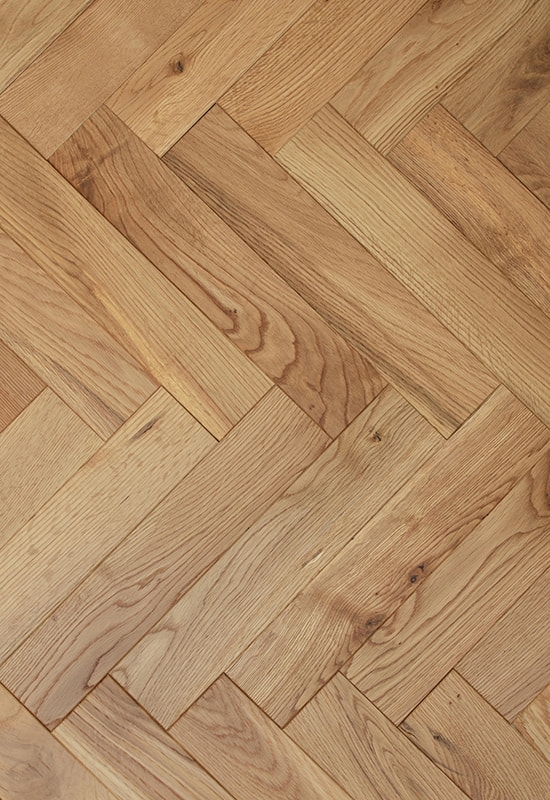
Herringbone is the entry point into patterned flooring for most buyers. Its staggered rectangular layout is immediately recognizable, works in both traditional and contemporary interiors, and is the most forgiving to install of the three. For retailers, herringbone products available in our herringbone engineered wood flooring range represent the strongest volume opportunity in patterned floors — the pattern that converts customers who are on the fence between standard planks and something more distinctive. Typical retail price positioning sits 20 to 40 percent above an equivalent straight-plank product in the same species and finish.
Chevron commands a further step up. Because each plank must be cut to a precise angle — typically 45 or 60 degrees — so that the ends meet in a clean, unbroken V, the manufacturing tolerance required is tighter and installation skill demands are higher. The visual result is sharper and more geometric than herringbone, which appeals to customers with a design-forward sensibility. Browse the full chevron flooring collection to see the range of species and angles available. Chevron products typically retail at 30 to 55 percent above straight planks and attract buyers who have already decided they want something premium — the closing conversation is about species and finish, not whether to pay more.
Design parquet — including basket-weave, Versailles, and custom multi-species compositions — sits at the top of the range and is best treated as a special-order or project category rather than a standard stock item. Margins here can reach 60 to 100 percent above straight planks, but the sales cycle is longer and typically involves architects, interior designers, or developers rather than end consumers acting alone. Our design parquet flooring range is the right starting point for retailers looking to develop this segment.
Building a Good-Better-Best Product Range
The single most effective structural change a flooring retailer can make to increase average order value from patterned floors is to stop presenting products as a flat catalog and start presenting them as a deliberate three-tier range. The Good-Better-Best framework works because it reframes the customer's decision from "should I buy this?" to "which level is right for me?" — a subtle but commercially significant shift.
A practical example for a white oak parquet range might look like this. At the Good tier: a 14 mm herringbone in a brushed natural finish, positioned as accessible and contemporary. At the Better tier: a 20 mm herringbone in a smoked or UV-oiled finish, with a wider plank for a more architectural feel. At the Best tier: a 20 mm chevron or design parquet in a hand-scraped or wire-brushed finish, available in wider widths and longer lengths that give rooms a genuinely bespoke quality.
The key discipline is ensuring that each tier is visibly and tangibly different in your showroom. If customers cannot see and feel the difference between tiers, they will default to the lower price. When the difference is obvious — in plank width, surface texture, sheen level, and the crispness of the pattern joints — the Better and Best tiers sell themselves. Research on which pattern configurations resonate most strongly in different markets is covered in our article on which flooring pattern sells best, which is useful reading when planning range architecture by sales region.
Showroom Tactics That Sell the Pattern, Not Just the Price
Patterned floors are experiential products. A customer who sees a 30 cm sample tile of herringbone will not feel what a full herringbone room feels like. Retailers who invest in large-format display areas for parquet consistently report higher conversion rates and higher average transaction values from those displays — not because the product changed, but because the customer was able to imagine it in their own home.
The minimum effective display size for herringbone or chevron is approximately 1.5 m × 1.5 m of laid floor, ideally raised on a low platform so customers can look across the surface at a natural angle rather than straight down. At this size, the repeat of the pattern becomes fully legible and the directional movement that makes patterned floors so compelling in real rooms starts to come through.
Lighting matters more for patterned floors than for straight planks. A raking light source positioned to cast shallow shadows across the floor surface will reveal texture, grain, and the geometry of the pattern joints in a way that overhead fluorescents never will. If your showroom has fixed overhead lighting, a single adjustable floor lamp placed near your parquet display at an angle of roughly 20 to 30 degrees from horizontal will make the difference visible immediately.
Short installation time-lapse videos, played on a screen adjacent to the display, serve two purposes: they educate customers on what professional installation looks like, reinforcing the skilled-trade premium in their minds, and they give salespeople a natural conversational anchor when discussing why the floor costs more to install than a straight plank.
Talking Points to Handle "Why Is It More Expensive?"
Every salesperson selling patterned floors at a premium will encounter this question. The retailers who handle it most effectively do not apologize for the price or retreat to discounting. They redirect the conversation from cost to value, using a consistent set of talking points that are grounded in facts the customer can verify.
Below is a framework that works consistently across customer types.
- Lead with longevity, not aesthetics. "This floor is designed to be refinished two or three times over its life. In 20 years, you can sand back the surface and it looks new again. That changes the cost-per-year calculation significantly compared to something you replace in a decade." Customers who are already spending on a renovation respond to this framing because it aligns with how they are already thinking about their home.
- Quantify the installation premium, then contextualize it. "The installation for a herringbone floor typically runs about 35 to 40 percent more than a straight plank installation. On a 40 m² room, that might be an extra €400 to €600 in labor. Spread across the life of the floor, that is less than €30 a year for a floor that looks architecturally considered rather than standard." Breaking the premium into a per-year figure consistently reduces the perceived barrier.
- Reference the resale conversation. "Estate agents in most markets will tell you that original parquet or herringbone floors are a selling feature they actively mention in listings. It is one of the few flooring choices that tends to add more perceived value to a home than it costs to install." This is particularly persuasive for customers who are renovating a property they may sell within five to ten years.
- Use the contrast principle. Keep a straight-plank sample adjacent to your herringbone display and let the customer hold both. Without saying anything comparative, allow them to place the herringbone piece on the display floor. Most customers answer their own question within thirty seconds of doing this.
Pairing Patterns With the Right Species and Finish
The combination of pattern, wood species, and surface finish is where a retailer can add genuine expertise value — and where the most significant upsell opportunities exist. Each pairing creates a different room character, and guiding customers to the right combination positions the retailer as a design consultant rather than a product vendor.
White oak herringbone with a wire-brushed or UV-oiled finish is the most commercially reliable pairing in the current market. The open grain of white oak reads clearly through a herringbone pattern, the wire-brushed texture adds tactile richness, and the oil finish keeps the floor looking close to raw timber rather than lacquered. This combination works across Scandinavian, French-country, and contemporary interior styles — the broadest possible appeal for a Better-tier product.
Smoked white oak in a chevron layout represents the strongest premium positioning for retailers targeting design-conscious buyers. The warm grey-brown tones of thermally modified or fumed oak, combined with the sharp geometry of the chevron V, creates an interior that reads as both modern and deeply considered. This pairing is particularly effective in open-plan kitchen-dining spaces where the floor pattern becomes a major design element.
Natural black walnut in herringbone or chevron is the correct recommendation for customers seeking warmth and richness over the cooler palette of oak. Walnut's natural chocolate tones intensify the visual depth of a patterned layout, and its higher price point as a species makes it a natural fit for the Best tier of a product range.
For guidance on how to match pattern choice to room proportions and architectural style — content you can share directly with customers or designer clients — our article on choosing the right parquet pattern for your space provides a detailed framework that supports the in-store conversation.
Parquet patterns are not merely an aesthetic upgrade — they are a structural commercial opportunity for any flooring retailer willing to invest in the right stock, the right display environment, and a sales team that can articulate the difference between price and value. The customers willing to pay a premium for a herringbone or chevron floor are already in your showroom. The question is whether your range and your team are ready to convert them.

 +86-572-2118015
 No.598. Gaoxin Road, Huanzhu Industrial Zone, Huzhou City, Zhejiang Province, China, 313000