

 Eng
Eng  English
 中文简体
中文简体 Français
Content
Most first-time importers don't fail because they chose the wrong wood species or miscalculated freight costs. They fail because they skipped a step — or didn't know the step existed. Sourcing wood flooring directly from China can cut your landed cost significantly and unlock product ranges that local distributors simply don't carry. But the process has real complexity: supplier verification, certification compliance, shipping documentation, and customs clearance each carry their own risks. Get them right in sequence, and the whole process becomes repeatable. This guide walks you through the five steps that matter most.
Step 1: Define Exactly What You Need Before You Search
Vague specifications lead to vague quotes — and expensive surprises after production. Before you contact a single supplier, lock down your product requirements in writing. This document becomes your RFQ (Request for Quotation) and protects you throughout negotiation.
Start with the core product decisions:
- Construction type: Are you sourcing engineered wood flooring or solid wood flooring for high-end residential projects? Engineered flooring dominates export volumes because it ships more stably and suits a wider range of subfloor conditions.
- Species and grade: White oak is by far the most exported species from China, but walnut, teak, and ash have strong market demand depending on your region. Specify the grade (Select, Natural, Rustic) and whether knots or color variation are acceptable.
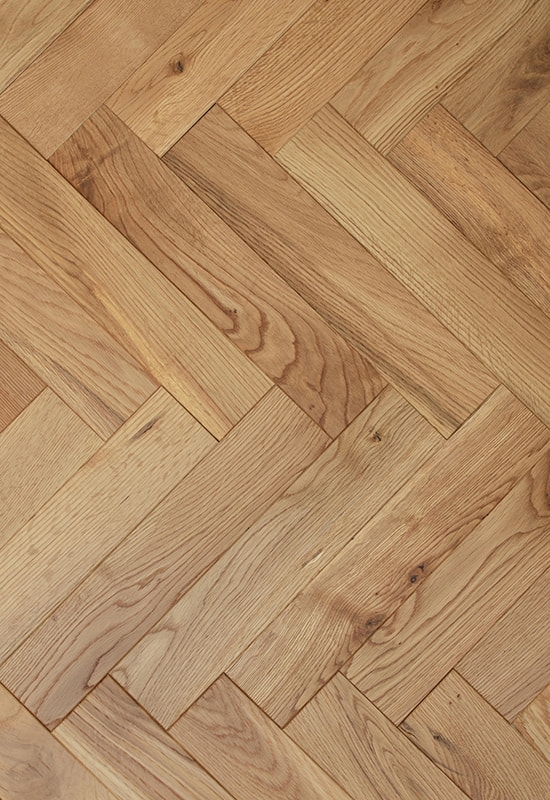
- Format and dimensions: Standard plank, herringbone wood flooring patterns, or chevron wood flooring options? Specify width, length, and thickness. Wide planks (180mm+) require longer lead times and carry different pricing.
- Surface finish: UV lacquer, hardwax oil, brushed, smoked, or unfinished? The finish affects both aesthetics and the certifications you'll need to verify.
- Installation system: Tongue-and-groove, click-lock, or glue-down? This affects compatibility with your end customers' installation methods.
Also consider whether you need design parquet flooring styles for higher-margin project work. Having a clear product brief at this stage saves weeks of back-and-forth later and makes it far easier to compare quotes across multiple suppliers on an equal basis.
Step 2: Find and Vet a Reliable Manufacturer
The single most consequential decision in the entire import process is choosing who to buy from. China has over 1,200 engineered wood flooring manufacturers, concentrated mainly in Zhejiang (Huzhou) and Jiangsu (Changzhou). Not all of them are factories — a significant portion are trading companies who resell products from multiple factories without controlling production quality.
For a first-time import, working directly with a manufacturer is strongly preferable. Here's how to tell them apart:
- Ask for the factory address and request a video call walkthrough. Legitimate manufacturers will show you the production floor, kiln drying equipment, and finishing lines without hesitation.
- Check export records. Platforms like ImportYeti or Panjiva allow you to search verified US customs shipment data. A manufacturer with a real export history to your region is a significantly lower risk than one without.
- Review certifications proactively. Ask for copies of CARB, FSC, or CE certificates before discussing price. A factory that hesitates to share these documents is sending you a clear signal.
- Ask about MOQ and lead time for your exact specification. Standard products typically have an MOQ of 300–800 square meters. Custom finishes or dimensions will push that higher and add 10–15 days to production lead times.
Trade platforms like Alibaba and Made-in-China are legitimate starting points, but always move the conversation off-platform and into direct email or video communication as quickly as possible. Factories that handle serious B2B export business expect this and respond accordingly.
Step 3: Request Samples and Verify Certifications
Never place a bulk order based on product photos. Always request physical samples — and treat the sample review process as your quality control gate.
When samples arrive, check for the following:
- Dimensional accuracy: measure width, length, and thickness against your specification
- Tongue-and-groove or click-lock fit: test assembly by hand across multiple boards
- Finish consistency: look for streaking, bubbling, or uneven sheen under direct light
- Veneer thickness: for engineered flooring, the top layer should be at least 2mm for a sanded product; 0.6mm for a rotary-cut face is a cost-cutting indicator worth flagging
- Odor: a strong chemical smell may indicate adhesive or finish that won't pass formaldehyde testing
Certification verification is equally critical, especially for the US and EU markets. The two most important standards for wood flooring importers are:
- CARB Phase II / EPA TSCA Title VI: These regulations govern formaldehyde emissions from composite wood products including engineered flooring with HDF or plywood cores. The US EPA's official formaldehyde emission standards set hard limits — hardwood plywood at 0.05 ppm, MDF at 0.11 ppm. Since March 2019, TSCA Title VI compliance labels are required for all composite wood products entering the US market. Ask your supplier for the certificate number and verify it directly with the issuing third-party certifier.
- FSC (Forest Stewardship Council): Required or strongly preferred by many European buyers and sustainable construction projects. If your target market demands FSC-certified product, confirm the factory holds a valid Chain of Custody certificate — not just a claim of using FSC-sourced timber.
For EU-bound shipments, also confirm CE marking requirements and whether the product needs to meet EN 14342 (wood flooring characteristics) or REACH compliance for chemical substances. These requirements vary by product type and destination country, so confirm with your local customs broker before production begins.
Step 4: Negotiate Terms, Place Your Order, and Arrange Shipping
Once you've confirmed samples and certifications, you're ready to move into commercial terms. For first-time orders, the standard payment structure in Chinese flooring exports is 30% deposit by T/T (bank wire transfer) before production, and 70% balance against the copy of the Bill of Lading. This structure protects both parties: the factory has commitment before cutting material, and you retain leverage until the goods are shipped.
Some factories will push for 50/50 terms on smaller first orders. This is negotiable, particularly if you can demonstrate a track record in your industry or offer a letter of reference.
On shipping, you have two primary options:
- FCL (Full Container Load): A 20-foot container holds roughly 1,200–1,500 sqm of engineered flooring depending on thickness and packaging. A 40-foot container doubles that. FCL is more cost-efficient per sqm and gives you full control over your container, reducing handling damage risk.
- LCL (Less than Container Load): Suitable for smaller trial orders below 10–12 CBM. Expect higher per-sqm freight costs, more handling touchpoints, and slightly longer transit times due to consolidation at the origin port.
Work with a freight forwarder who has experience in Chinese wood product exports. They'll handle booking, container loading supervision (or appoint a third-party inspector to do so), and coordinate the shipping documents you'll need for customs: commercial invoice, packing list, Bill of Lading, and certificate of origin. If your market requires a fumigation certificate or phytosanitary inspection for wooden packaging materials, confirm this with your forwarder well before the loading date.
Don't forget to include flooring accessories for complete orders — transitions, moldings, and underlays — in your initial quote. Sourcing these separately later is inefficient and often costs more.
Step 5: Clear Customs and Inspect Upon Arrival
Wood flooring from China enters most markets under HS Code 4418 (assembled parquet panels) or 4409 (profiled wood strips), though the exact subheading depends on construction type and whether the product is assembled or unassembled. Confirm the correct HS code with your customs broker before shipment — misclassification triggers delays and potential penalties.
Key documents for customs clearance typically include:
- Commercial invoice (stating unit price, quantity, and country of origin)
- Packing list
- Bill of Lading or Airway Bill
- Certificate of Origin (Form A or FORM E depending on your trade agreements)
- TSCA Title VI compliance certificate (for US imports)
- Fumigation certificate (required in many markets for solid wood packaging)
Once goods arrive at your warehouse, conduct a systematic incoming inspection before signing off on delivery. Check carton count against the packing list, open a random sample of 5–10% of cartons, and measure dimensions, inspect finish quality, and test click-lock or T&G fit. Document everything with photos. Any discrepancies should be reported to the supplier within the timeframe specified in your purchase contract — typically 7–14 days after arrival.
For guidance on matching product specifications to specific project types, how to recommend the right wood floor for renovation projects covers the key decision points your clients will raise.
First imports always take longer than expected. Build a realistic timeline: 3–5 days for sample exchange and approval, 25–35 days production lead time, 20–35 days ocean transit depending on destination, and another 5–10 days for customs clearance and inland delivery. Planning for a 10–12 week total cycle on your first order is a practical baseline. Subsequent orders, once you've established the supplier relationship and logistics chain, typically run 20–30% faster.

 +86-572-2118015
 No.598. Gaoxin Road, Huanzhu Industrial Zone, Huzhou City, Zhejiang Province, China, 313000