

 Eng
Eng  English
 中文简体
中文简体 Français
Content
Wood does not stop reacting to air once it leaves the kiln. A hardwood floor keeps exchanging water vapor with the room around it, so the relative humidity (RH) inside the building — not the weather outside — decides whether the floor holds its shape or works against its fasteners. The short answer to the recommended humidity for hardwood floors: hold indoor RH between 30% and 50%, keep temperature near 60-80°F (16-27°C), and treat 35% to 55% as the practical maintained band, the wording many manufacturers use for engineered construction. Hold those conditions year round and a well-made floor moves so little most people never notice. Let them drift for weeks and the floor answers: boards shrink and gap in dry air, then swell, cup, or buckle when moisture climbs back.
Recommended Humidity for Hardwood Floors, by the Numbers
The National Wood Flooring Association (NWFA), whose installation guidelines are the reference most North American manufacturers and installers write into warranties, recommends 30-50% RH at 60-80°F. European and Japanese makers phrase it similarly, and most condition warranty coverage on the floor staying inside that band. Mid-band, wood settles at an equilibrium moisture content of roughly 7-9%, which is where kiln-dried flooring sits when it is packed — typically 8-10% moisture content for solid boards headed to temperate-climate markets.
Read the chart from the edges inward. Both extremes damage a floor, and the safe band is wide enough that comfortable living conditions and floor-safe conditions almost always coincide, which is why the same numbers work in occupied homes from Osaka to Chicago.
What Happens Outside the Safe Band
Too dry: shrinkage, gaps, and checks
When RH falls, boards lose moisture and shrink across the grain. Flatsawn boards shrink roughly twice as much across their width as quartersawn ones, so wide plank floors show the movement first. Gaps appear between boards; sustained dryness adds surface checks and splits on wide boards, squeaks, and loosened fasteners. Seasonal gaps that close again when humid weather returns are normal wood behavior. Gaps that stay open in mid-summer, or checks that run through the face of a board, mean the floor was pushed below its installed moisture content, and that damage does not reverse.
Too damp: swelling, cupping, and buckling
When RH stays high, grain at the face absorbs vapor and expands faster than the grain beneath it, lifting board edges into a shallow trough called cupping. Push further and swollen boards press against each other, edges crush, and the floor can lift off the subfloor in buckling. Sustained RH above about 70% also raises mold risk in and under the floor. Where cupping has already begun, correct the humidity first, then read this guide to wood floor cupping before touching sandpaper.
| Indoor RH band | Wood response | Visible symptoms | Recommended action |
|---|---|---|---|
| Below 25% | Rapid moisture loss toward 4-5% MC | Gaps open, surface checks on wide planks, squeaks, loose fasteners | Run humidification and monitor MC before boards split |
| 25-35% | Slow, mostly seasonal shrinkage | Minor gapping on flatsawn boards that closes again in summer | Acceptable short term in cold winters; humidify toward 35% |
| 35-55% | Wood MC holds near 7-9%, matching manufacture | Normal movement under roughly 1 mm on a 125 mm board | Target band; keep it stable under humidistat control |
| 55-70% | Face grain swells as vapor is absorbed | Slight cupping, boards rub, finish lines whiten at joints | Dehumidify; improve ventilation in basements and kitchens |
| Above 70% | Sustained gain toward 13%+ MC | Cupping, crowning, buckling, mold risk under the floor | Active dehumidification; find leaks and inspect the subfloor |
Equilibrium Moisture Content and Real-World Movement
The range exists because wood equalizes. Leave a board long enough in air of a given humidity and it reaches a moisture content where it neither gains nor loses water:
- 30% RH settles wood near 6% moisture content
- 50% RH settles it near 9%
- 70% RH pushes it toward 13%
Between those points, a flatsawn white oak board changes width by roughly 0.25% to 0.30% per moisture point. On a 125 mm plank one point is about 0.35 mm; a 203 mm board nearly doubles that. A floor that slips from 50% RH in September to 32% RH in February spans about 2.5 moisture points, enough to open 0.8-1.0 mm gaps on a flatsawn 125 mm plank: visible, audible, and normal. The same drop on a 203 mm solid board, or on a floor installed at too high a moisture content to begin with, is what turns movement into damage. Board width, saw pattern, and species therefore sit alongside the humidity target in every serious specification.
Seasonal Shifts and Cold-Climate Adjustment
One RH number does not work across a year in a heating climate. Central heating can pull an airtight home below 20% RH in January while the same rooms sit near 55% in August. Widely used cold-climate practice lowers the indoor cap as average outdoor temperature falls:
| Average outdoor temperature | Suggested indoor RH | Practical note |
|---|---|---|
| 40°F (4°C) | 45% | Default band for milder winters |
| 30°F (-1°C) | 40% | Comfortable for occupants and floor alike |
| 20°F (-7°C) | 35% | Humidification usually needed in heated homes |
| 10°F (-12°C) | 30% | Minor seasonal gapping is normal here |
| 0°F (-18°C) | 25% | Portable humidifiers struggle; plan capacity |
| -10°F (-23°C) | 20% | Whole-house humidification and sealed air leaks |
Humid coastal regions, monsoon climates, and homes over crawl spaces push the other way and make dehumidification the project requirement. For buyers sourcing across borders, the regional mismatch is a real procurement risk: flooring packed at 8-10% moisture content for a temperate European market and installed in a desert or tropical interior without climate control will move immediately, whatever its quality. Manufacturers who ask for the destination climate can produce to a target moisture content for that market, which is worth confirming before an order is placed.
Monitoring and Control That Holds the Band
Controlling the band takes hardware and routine, not good intentions. The sequence that holds up on real projects:
- Measure with a calibrated hygrometer in the rooms the floor serves, including the driest and the dampest room, and check wood moisture content with a pin meter at installation rather than trusting air RH alone.
- Size humidification and dehumidification to the climate; portable units handle single rooms, while whole-house systems tied to the HVAC hold a tighter band.
- Service the HVAC on schedule, because a drifting thermostat or a clogged coil quietly changes indoor RH.
- Isolate ground moisture: a vapor barrier over crawl-space soil and sealed basement slabs do more for floor stability than any appliance.
- Acclimate the flooring on site, cross-stacked with airflow, until board moisture content lands within two to four percentage points of the subfloor, which usually takes three to seven days.
- Clean with manufacturer-approved methods, since repeated wet cleaning drives moisture into joints and undoes everything above.
Matching Construction to Climate and Buyer Risk
How much a floor responds to the band you maintain depends heavily on construction, which is where the humidity target meets product selection.
Solid hardwood
Solid boards move the most and reward tight humidity control, especially above widths of about 150 mm; quartersawn stock cuts movement roughly in half versus flatsawn. In stable year-round climates, solid flooring offers maximum service life and can be resanded many times, which keeps it the premium choice across much of Europe and Japan.
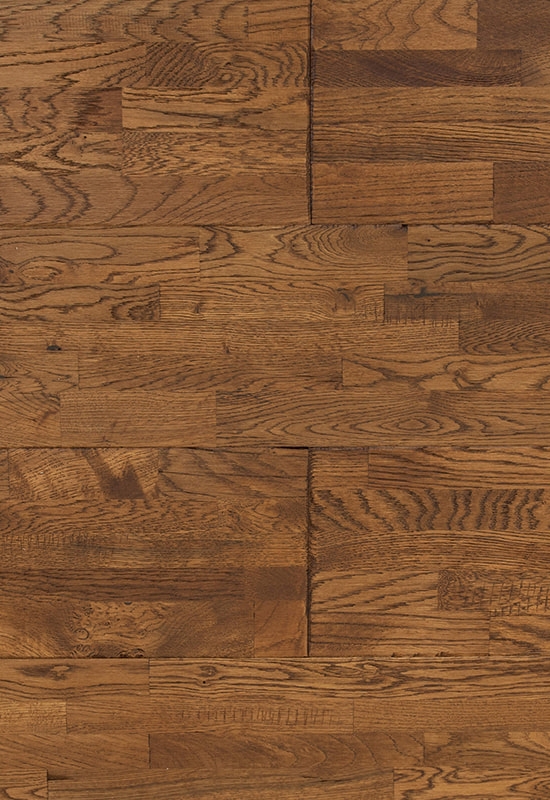
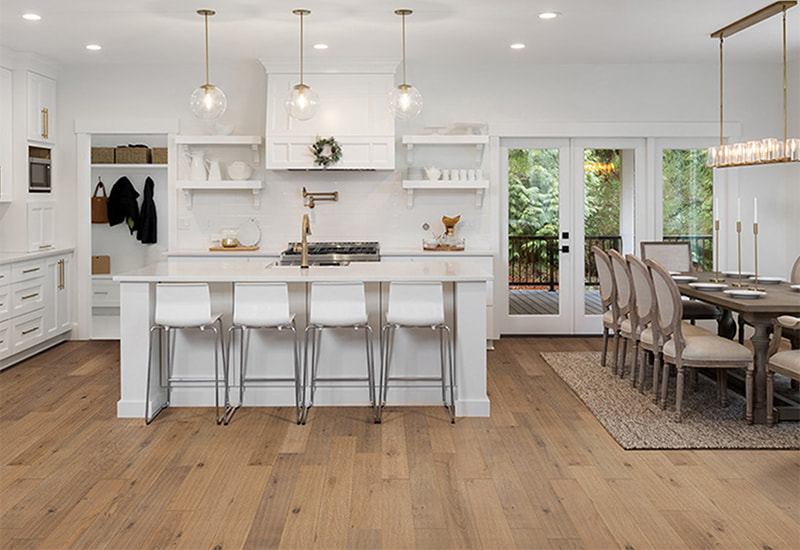 White Oak 125 Hand-Scraped + Brushed Solid Wood FlooringAn 18mm solid white oak plank in 125mm width with hand-scraped and brushed texture and UV lacquer. In stable, humidity-controlled climates, solid boards like this offer maximum service life and can be resanded many times.View Product →
Engineered plank
Cross-laminated cores counterbalance each layer, so engineered wood flooring typically tolerates RH swings of roughly 35% to 55% and pairs with underfloor heating. For variable climates, wide-plank looks, and retrofit projects, it is the lower-risk specification.
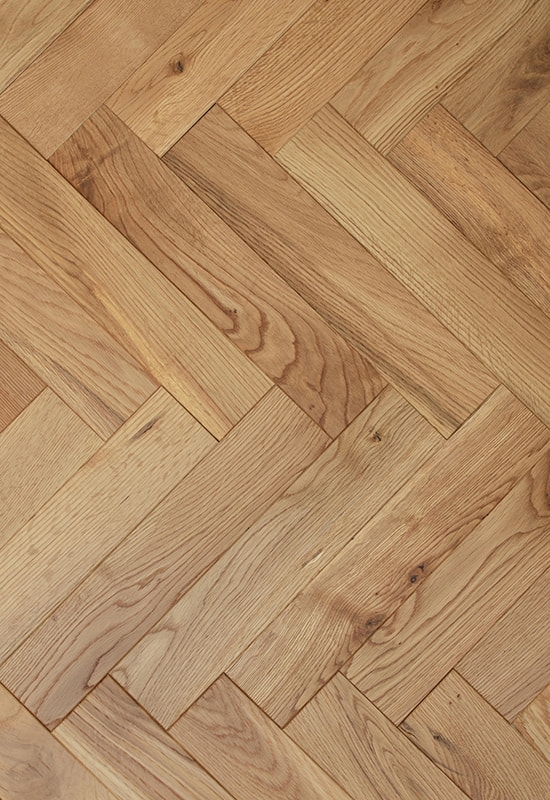
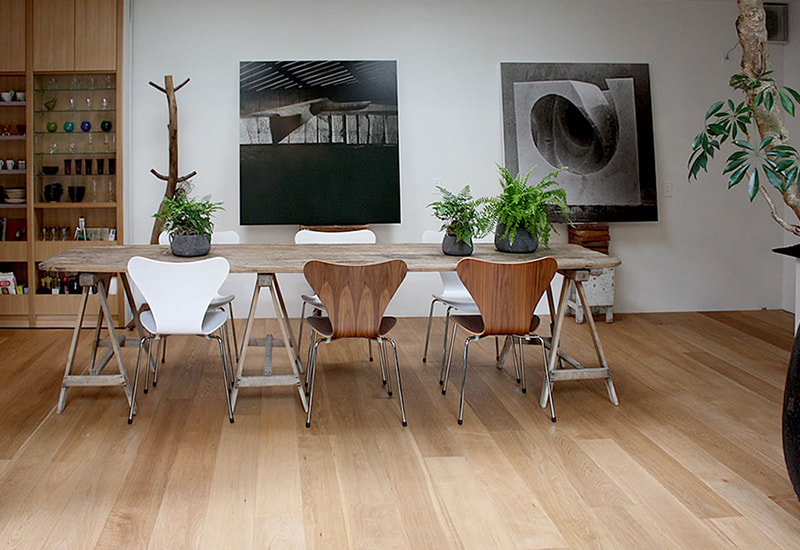 Natural White Oak Light-Brushed Engineered FlooringCross-laminated engineered white oak with standard bevel and light-brushed finish, offered in multiple thicknesses and widths. Its layered core tolerates humidity swings of roughly 35–55% RH and suits underfloor heating, retrofits, and wide-plank designs.View Product →
HDF engineered
HDF-core engineered flooring adds a high-density fiberboard core with low swelling behavior, one reason the format has taken over much of the European market. It also holds precise click profiles and tight tolerances through humidity cycles.
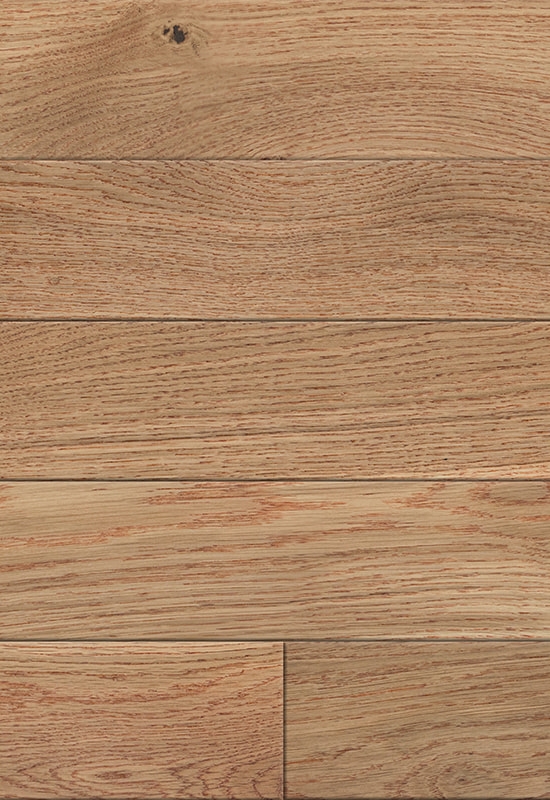
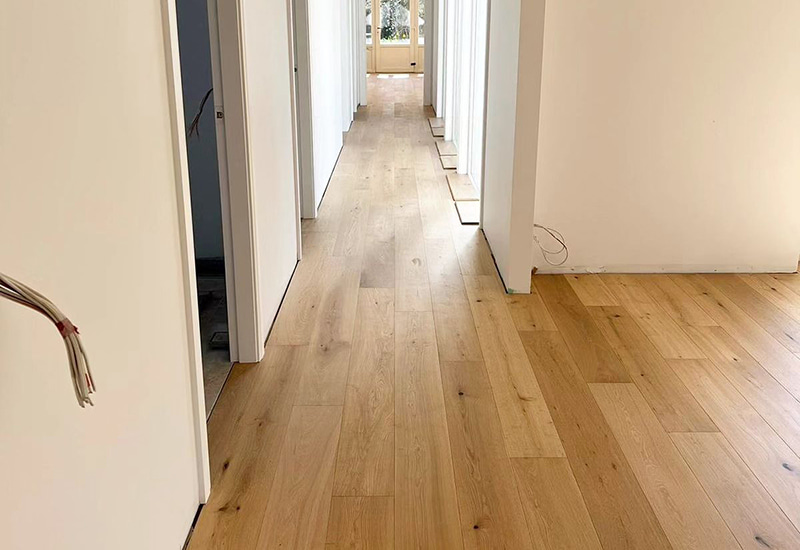 Natural White Oak HDF-Core UV Lacquer FlooringWhite oak flooring on a low-swelling HDF core with a durable UV-cured lacquer and open-pore finish. It holds tight click tolerances through humidity cycles, helping explain the format's popularity across the European market.View Product →
Procurement checks before ordering
- Ask for moisture content documentation per production batch and confirm the target against the destination climate.
- Specify container packaging with moisture protection, since condensation during ocean freight can raise board moisture before the floor is unloaded.
- Confirm the warranty's stated RH band matches what the building can actually hold; a project without mechanical humidity control cannot honestly commit to 30-50% year round.
- Check that quality control covers every production stage and that finishes and adhesives are third-party tested, because humidity cycling stresses coatings and glue lines as much as the wood.
As a manufacturer shipping to Europe, North America, and Japan, JESONWOOD builds around these checks, with whole-process inspection, periodic third-party testing of inputs, and certifications such as FSC, PEFC, CE, and JAS for buyers whose procurement standards demand them.
A workable summary: hold 30-50% RH and aim for mid-band, trim the ceiling in deep winter, measure wood moisture content instead of trusting the thermostat, choose construction that matches the climate swing the building will actually see, and confirm humidity and warranty terms before the order is signed. Floors installed inside those conditions are boring in the best sense: they stay flat, tight, and quiet for decades.

 +86-572-2118015
 No.598. Gaoxin Road, Huanzhu Industrial Zone, Huzhou City, Zhejiang Province, China, 313000