

 Eng
Eng  English
 中文简体
中文简体 Français
Content
Why the Janka Scale Is the First Hardness Reference in Flooring
When a customer asks for a hardwood floor that will survive an open kitchen with two large dogs and a rolling office chair, the conversation usually starts with the Janka scale. The test, developed by Austrian-born researcher Gabriel Janka, measures how much force is required to press a steel ball halfway into a piece of wood. That force, expressed in pounds-force, gives a practical ranking of dent resistance. It does not tell you everything about a floor, but it is the best starting point we have for comparing species.
In our years as a wood flooring manufacturer, we have seen most specification mistakes happen when a buyer chooses a species by colour alone and ignores hardness. The Janka scale is the industry's common language for that missing information. It helps you separate a delicate dark walnut from a dense tropical hardwood before you commit to a full order.
How the Janka test is performed
The test uses a steel ball with a diameter of 11.28 mm, or about 0.444 inches. A press pushes the ball into the wood until half of the ball is embedded. The amount of force needed to reach that point is the Janka rating. Because grain direction and moisture content affect the result, samples are tested at a standard moisture level and taken from several boards. The higher the number, the more force the wood can absorb before it dents.
How to read Janka ratings
Ratings below 1,000 lbf are rarely suitable for a floor surface in a busy room. Most domestic hardwoods used in flooring sit between 1,200 and 1,800 lbf, while the hardest tropical species can exceed 3,000 lbf. A rating of 2,000 lbf or more is generally enough for high-traffic residential areas and many light commercial spaces. Keep these ranges in mind when you look at a chart.
Janka Ratings for Common Flooring Species
The table below gives approximate values for species that appear regularly on flooring orders. Use them as comparisons, not absolute guarantees. A particular board can vary by several percent depending on its growing site and how it was dried and sawn.
| Species | Janka Hardness (lbf) | Typical Flooring Notes |
|---|---|---|
| Cumaru (Brazilian Teak) | 3,540 | Excellent dent resistance; hard on cutting tools; suited to busy rooms and light commercial spaces. |
| Jatoba (Brazilian Cherry) | 2,350 | Warm reddish colour; high hardness; a practical choice for stairs and high-traffic areas. |
| Merbau | 1,925 | Good hardness and moisture resistance; often used in solid and engineered formats. |
| Hickory | 1,820 | The hardest common domestic hardwood; dramatic grain; good for family spaces. |
| Hard Maple | 1,450 | Pale, clean look; dense and moderately hard; popular for contemporary interiors. |
| White Oak | 1,360 | A balanced species; hardness plus good stability; widely used for planks and parquet. |
| Red Oak | 1,290 | Classic North American flooring; slightly softer than white oak; easy to work. |
| Black Walnut | 1,010 | Much softer; rich dark tone; better in low-traffic and adults-only areas. |
Domestic hardwoods
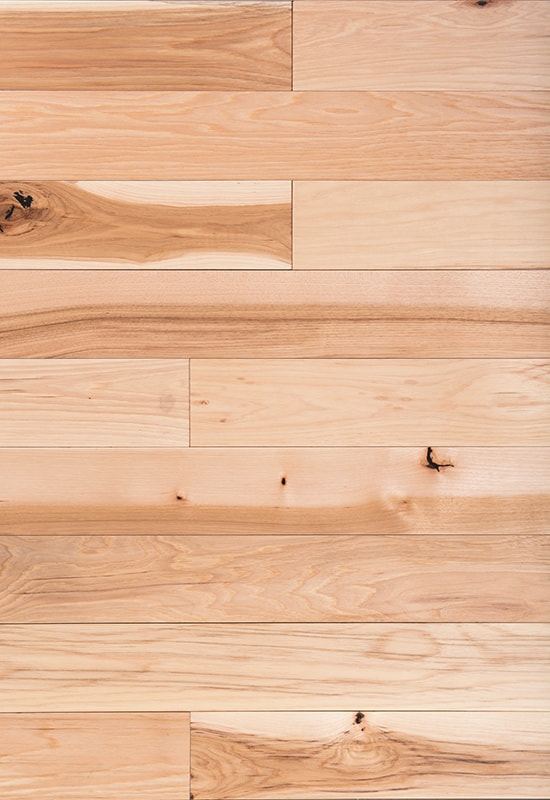
Among temperate species, hickory is the hardest common choice, with a rating around 1,820 lbf. Its grain is more pronounced than oak, and it suits family rooms where occasional impact is likely. White oak and red oak are the most familiar options: white oak averages about 70 lbf harder than red oak, which is a small difference in daily use but enough to make white oak the preferred species for kitchens and entryways.
For a family room where toys, chairs, and pet claws are part of normal life, hickory is a reliable choice. Our hickory solid wood flooring gives you the same dense surface in a 90 mm strip with a flat profile.
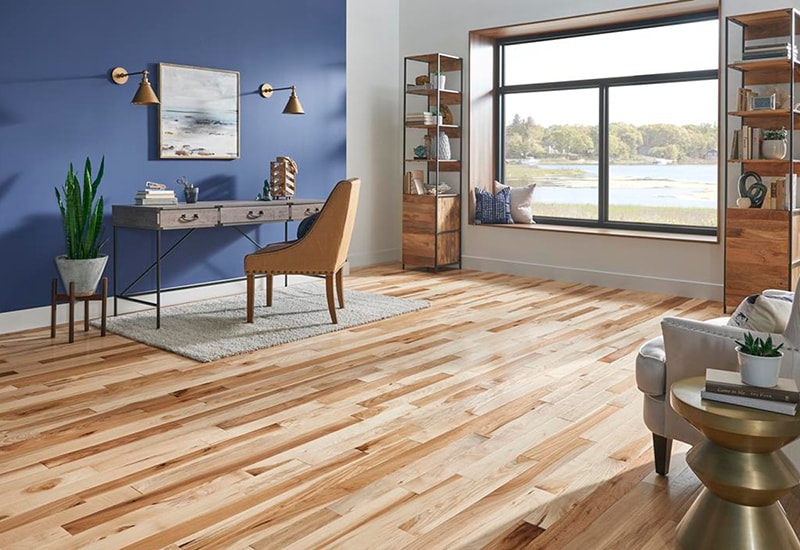 Hickory 90 Flat Solid Wood Flooring Suppliers, FactoryJesonwood Forest Products(ZJ) Co., Ltd. is China Custom Hickory 90 Flat Solid Wood Flooring Suppliers and Hickory 90 Flat Solid Wood Floo...View Product →
Tropical hardwoods
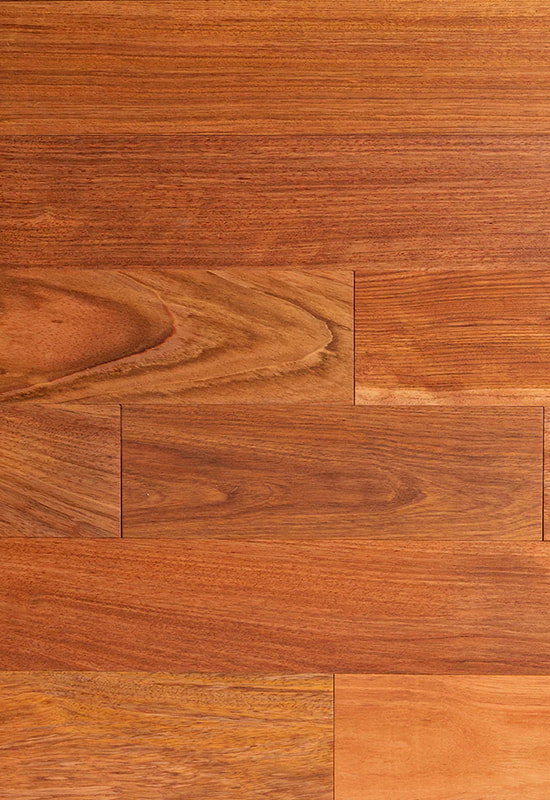
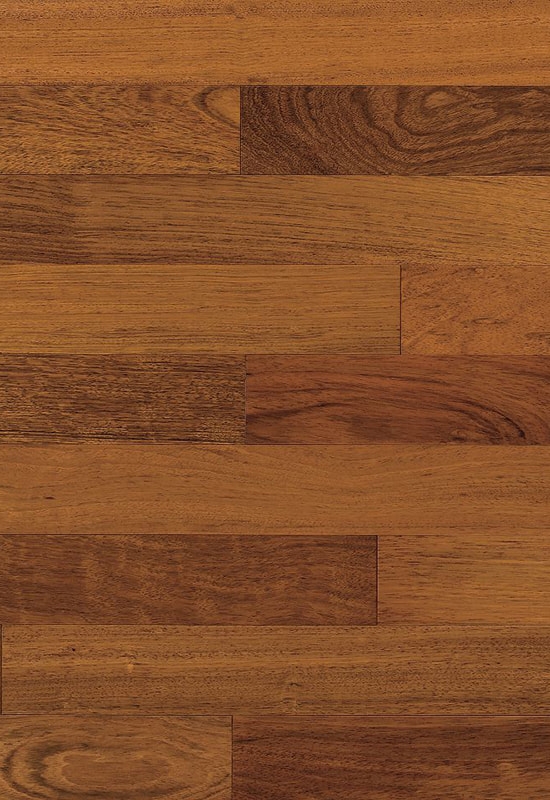
Tropical species dominate the upper end of the Janka scale. Cumaru, often called Brazilian teak, typically measures around 3,540 lbf, while Jatoba, known as Brazilian cherry, comes in near 2,350 lbf. Both are hard to dent and are common choices for stairs, halls, and open-plan spaces. Jatoba has a warm reddish tone that darkens with age, and its hardness makes it practical for high-traffic surfaces. For a solid Jatoba board with a flat surface, our Jatoba solid wood flooring is a direct option.
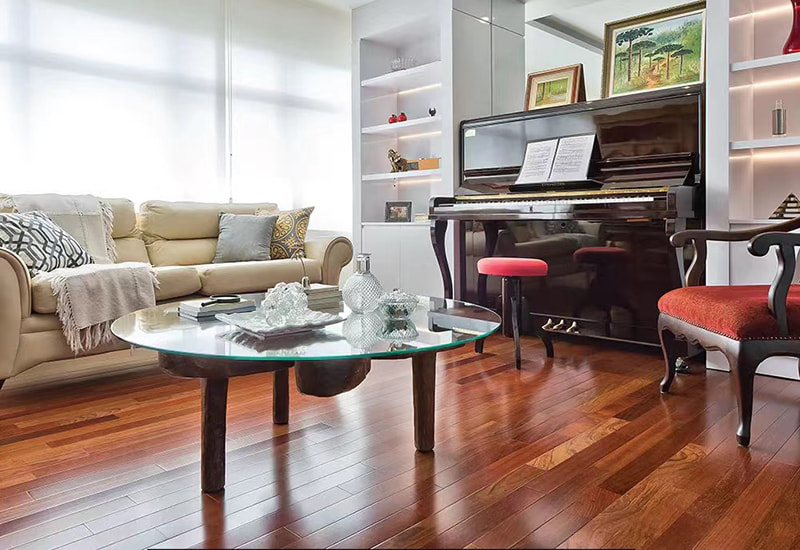 Jatoba 90(120mm) Flat Solid Wood Flooring Suppliers, FactoryJesonwood Forest Products(ZJ) Co., Ltd. is China Custom Jatoba 90(120mm) Flat Solid Wood Flooring Suppliers and Jatoba 90(120mm) Flat Sol...View Product →
What a Higher Janka Rating Does and Does Not Tell You
A high Janka rating is a useful measure of dent resistance, but it is not a measure of total durability. A floor can fail through scratching, staining, cupping, or finish wear, and none of those problems is captured by the hardness number. If you treat the Janka scale as the only selection criterion, you may end up with a floor that is hard yet unsuitable for your climate or installation method.
Dent resistance versus surface wear
Dents are caused by focused impact, such as a falling tool, a chair leg, or high heels. Scratches are caused by abrasive particles dragged across the surface. A hard species can be more resistant to dents, but the finish layer does much of the work against scratching. This is why we ask clients what kind of wear they expect. A floor in a shoe-free household may not need the hardest species; a floor beside a garden entrance may need a tougher finish more than a higher Janka number.
Stability and construction also matter
The Janka test says nothing about how a board reacts to humidity, underfloor heating, or seasonal changes. A very hard tropical species can be stable, but only if the boards are properly dried, matched to the right core, and installed with the correct expansion gap. The same logic applies to finish: a hard substrate still needs a wear layer that can be maintained. For many projects, a balanced species like white oak is a better overall bet than the hardest available tropical wood. The choice between solid and engineered construction can also change the long-term performance of the same species. See how we compare solid and engineered constructions in our solid vs engineered wood flooring comparison.
Using the Janka Scale When You Order Wood Flooring
Start your selection with the Janka scale, then narrow down by colour, grain, and price. The right specification is one where hardness matches the room's traffic and the conditions of the installation. There is no single correct number: a black walnut floor in a quiet library can serve a homeowner perfectly, even though its rating is only about 1,010 lbf.
Match the rating to the room
For a busy kitchen, a main hallway, or an open family area, aim for species at or above 1,800 lbf if the budget allows. For bedrooms, studies, and rooms that see lighter use, 1,200 to 1,400 lbf can be perfectly serviceable. For light commercial spaces such as boutique retail stores or offices, a rating of 2,000 lbf or more is a safer starting point. After you narrow down the hardness range, the aesthetic choices become easier.
Balance hardness with workability and cost
Harder species are more difficult to cut, sand, and nail. This can raise installation time and tooling costs. Very hard exotic woods also tend to be more expensive, and some require special handling during acclimation. A 3,500 lbf species is not automatically better than a 1,360 lbf white oak if the project does not need that level of impact resistance. White oak is a good example of balance: its hardness covers most residential rooms, its workability is manageable, and its neutral colour works in many interior schemes. If you prefer the same species in an engineered format, our engineered white oak plank gives you the familiar surface in a dimensionally stable board.
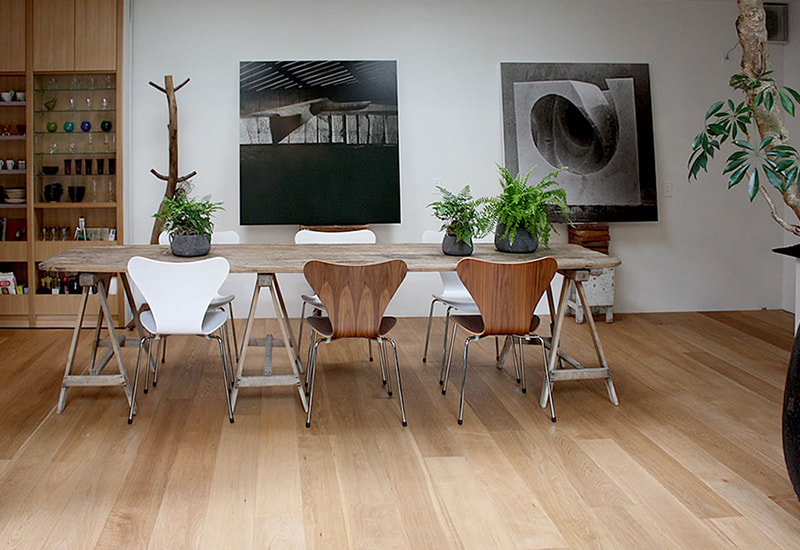 Natural White Oak OA001-9 Suppliers, FactoryJesonwood Forest Products(ZJ) Co., Ltd. is China Custom Natural White Oak OA001-9 Suppliers and Natural White Oak OA001-9 Factory in China,View Product →
When you compare multiple candidates, look beyond the single hardness number. A practical guide to durable wood flooring options can help you weigh the Janka value against construction, finish, and maintenance. And when you are making recommendations for a specific renovation, our approach to choosing wood floors for renovation projects shows how to connect the rating to real living conditions.

 +86-572-2118015
 No.598. Gaoxin Road, Huanzhu Industrial Zone, Huzhou City, Zhejiang Province, China, 313000